The Ultimate Collection of Principles of Design Examples and Definitions
Table Of Content
As you read this infographic, your eyes naturally move from one element to the next in a Z pattern. In the chart at the top, aligning the bars in the graph to the left makes it easy to digest the data. And the bottom section shows how aligning the icons with the text below them makes each one its own contained piece of information. For visual consistency, the two section headings align with each other too.
Why Is Art Important? – The Value of Creative Expression
By combining these techniques, an artist can create rhythm that helps to guide viewers through their artwork. Repetition refers to cases where elements are repeated without much variation. Rhythm and repetition are another common pair in the principles of art. Incorporating repeated elements that match one another in an image can be pleasing to the viewer. Therefore, artists often attempt to create work with elements that match one another.
Visual Design: The Ultimate Guide
Color provides the most psychological aspect of design, as it's how most humans see reality. In design, color tells a story, sets the mood, and adds character and personality. The image above is mostly made up of shapes - from the large circle depicting the sun to the birds and the silhouette-like buildings.
Art Periods – A Detailed Look at the Art History Timeline
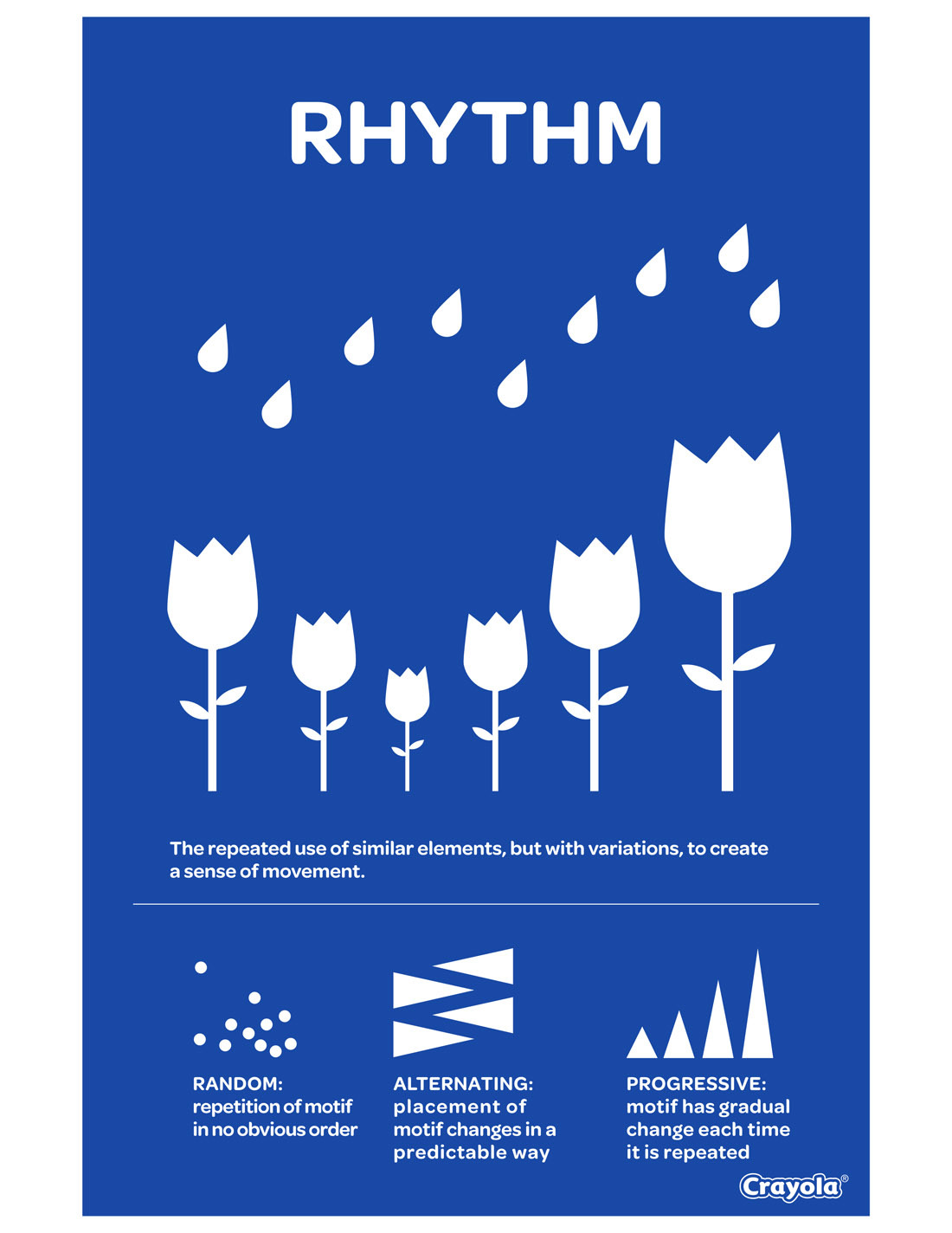
Movement, repetition, and pattern are often used interchangeably with rhythm, though they all differ slightly. Despite their obvious similarities, it is important to highlight their distinctions. A random rhythm will contain repeating elements, but they will be repeated in an irregular fashion.
The Power of White Space in Design
While Lizards is mechanical, the artist’s style does shine through. There is a playfulness in the fact that the lizards look like puzzle pieces. As a principle of design, rhythm describes the combination of elements that often results in the illusion of movement. One of the best ways to use repetition and rhythm in web design is in the site's navigation menu.
For example, varying the color of an object or changing its scale can provide contrast which gives the artwork movement and visual interest. Movement can be thought of in two ways – the first refers to how an artist depicts movement using the elements and principles of art. The second way refers to the visual flow of an artwork, indicated by the path a viewer’s eyes take as they look at the artwork. Let us start with the regular rhythm in art, which is simply what its name suggests, regular. Whether different art elements are utilized, for example, color, line, or shapes, these are arranged in even and consistent patterns.
Finn Juhl: Ancient Aesthetic and Modern Rhythm - Business Wire
Finn Juhl: Ancient Aesthetic and Modern Rhythm.
Posted: Thu, 08 May 2014 07:00:00 GMT [source]
Shape
When paired with unity, variety offers the viewer points of interest. With radial balance, like in the example of radial balance below, one can imagine the artwork as equal pieces of a pie. An artwork with radial balance is arranged around a central component.
However, usually similar art elements or motifs are arranged to create regularity. The principles of design can be applied to most artworks, but most of the principles also have subcategories that are important to highlight. Understanding what is rhythm in art requires a basic knowledge of the different ways in which rhythm can be created and utilized. These rhythm sections or types are regular, random, alternating, progressive, and flowing rhythm.

What is Scale in Art?
We often judge art by how effectively the artist used these design fundamentals even before we learn about them. This can take the form of a change in color, texture, or shape. You could also experiment with different scales, introduce negative space or throw in an unexpected detail that catches the viewer’s eye. By doing so, you create visual tension that keeps your audience engaged and interested.
They also add variety to the brochure (another important design principle I’ll cover later on!). Rather, it’s about ensuring the various elements of a design work well together, and you can do this in lots of ways. Knowing these elements and principles will help you see beyond what's tangible and produce more professional designs. To summarize, every piece of work uses point, line, shape, form, and color elements. These are the building blocks that form the visuals and structure. It's when every design element and principle comes together as one, creating harmonious flow and tranquility.
In the next section, we’ll dive deeper into the rhythmic aspect of repetition and explore the principle of rhythm. The horizontal lines between each entry stop the vertical flow momentarily, keeping you in each entry a little longer. The rhythm of the repeating colors in the dates and headlines pulls you further down the page once you’re ready to cross the horizontal line and move to another entry. The curve at the bottom of the logo appears to point downward leading your eye to the name of the wine being presented.
This technique can be especially effective when combined with other methods of repetition, such as line and shape. You’ve learned about the power of repetition in art, but let’s look at some specific examples of how artists have utilized this concept to create stunning works. These masterpieces showcase the artistic skill of the creators and prove that repetition is a technique that can stand the test of time.
Renoir alternates the blue of the lake and the woman’s dress, with the bright red of the boats. Artists will often plan the composition of their piece before they start working to establish the visual hierarchy of the different visual elements. This way they can predict where the viewer’s eye will be drawn to first and the tempo with which each element should be viewed. The use of repeated design elements is a controversial topic in the creative industry. By understanding the principles of rhythm, artists can better create dynamic compositions that captivate and move their audience.
As noted above, the use of repetition, pattern and rhythm are one of the key elements in enhancing and improving the experience for users. Whether it be in architecture or web design, the use of recognisable, repeating imagery or patterns allows users to identify their place within a wider structure. When thinking of design, we can consider issues including a core, central message or element in the design layout. Web design, for example, has a similar concept, where repetition allows for standardisation and consistency in approach. This can be done by using imagery or icons, or colors or text style, to provide the user with a simplified, consistent message across the platform. In this abstract work, the viewer's eye is drawn along a series of shapes and forms that continuously evolve and build upon each other.
Throughout her undergraduate years, she took Art History as an additional subject and absolutely loved it. Building on from her art history knowledge that began in high school, art has always been a particular area of fascination for her. Some examples frequently used from the world of sound include imagining the rhythm of a heartbeat, a clock, or a tap dripping.


Comments
Post a Comment